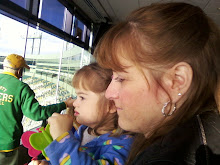
This weekend we went to the indoor waterpark for Mother's Day. It is kind of a tradition for us. Not that I love waterparks (as someone who wears contact lens it is not the best place to be with water splashing in your eyes), but I love seeing the boys have fun - so it is a great place to be in that respect. Quinn and I spent a lot of time together (and we forgot the camera of course)! Once we sat next to the lazy river. I was holding Quinn across my shoulder and I kept seeing these people floating by waving and smiling. I thought maybe they thought Quinn was cute or someone was behind us. Then when we got home last night, Quinn started to show her Miss America wave to me while sitting across the room. Up to this point, she tends to look at her hands a lot (so aggravating to try to break this behavior), but doesn't really use them to communicate other than signing more. She was really waving! I guess this was what she was doing to the people floating on the lazy river. And her clueless mom didn't realize - lol.
My final posting about Jonathan Mooney’s book involves the chapter “How to Curse in Sign Language.” It tells the story of a divorced mother, Deborah, and her decision to adopt a little girl, Ashley. Mooney said the following about Ashley’s needs: “Ashley had been born to an alcoholic, anorexic mother fourteen weeks prematurely. She weighed just over one and a half pounds, and her medical birth records state that she smelled of alcohol when she was delivered. A liver biopsy was performed right after her birth, and it showed that a tumor was present. She also had a ‘brain bleed.’ Even more threatening to Ashley’s health was a rare condition she had called Juvenile Xanthogranulomas, which causes tumors to form all over the body. These tumors, according to Deborah, ‘formed on Ashley’s skin, under her skin, on her eyes and ears, on other vital organs, and on her brain’” (p. 109). In addition to the above, Ashley has a seizure disorder and is blind and deaf, among having other medical difficulties.
However, as often is the case, this is not a sad story about a child with a disability – it is a story about love, acceptance, and ability. When Deborah first set eyes on Ashley she said “I thought she was beautiful. Her left eye, because of glaucoma, was about twice the size of her right eye. And although that skewed the symmetry of her face, she had a smile that lit up the room!” (p. 110). To tell the truth, prior to reading this, I used to think that I was someone who made a difficult, yet noble choice in having Quinn (given the prenatal diagnosis), but now I know that I am not such a person. The person who is noble is Deborah and people like her. She could have chosen any child or just to not adopt at all. She already had a son from her marriage. But she fell in calling in her heart to adopt and she fell in love with Ashley and Ashley alone. Ashley was the one. She saw Ashley for Ashley and did not fall into the trap that many of us do, seeing the disability first and then Ashley. I am ashamed to say that if this experience wasn’t placed upon me through the pregnancy, I would not be where I am today. I would never have read this book. I would never have looked at individuals with Down syndrome like I do today. I just adapted to what was given to me. It is people like Deborah who with love and faith make a true choice to bring a child with special needs. They are the heros and the noble ones. They are the ones with true love and faith in their hearts. In Mooney’s chapter, Deborah had many other salient things to say – like how the rejection is ten times worse than any of Ashley’s medical issues, that with love you can see beauty and ability, that we need to get beyond a view of fixing those who are not like others, and how having a sibling with a disability can enrich a child’s life.
If you are interested in this topic, check this inspiring story out. This is a family who experienced the same calling as Deborah.
In addition, please visit Reese’s Rainbow here, where there are many beautiful children with Down syndrome who need homes. They are now in countries around the world. These particular countries do not value individuals with Down syndrome and these children will be placed in a mental institution if not adopted. Almost every day I go and see Lera’s beautiful face here. I see she is on hold now – and I hope that is because she found a forever family. She deserves this just like Ashley does. You can also follow one family’s journey in adopting here. God bless all these beautiful people - Deborah, Ashley, and all these familiies and little ones who are or have experienced adoption.
I have been posting off and on about Jonathan Mooney’s book “The Short Bus.” I probably have two postings (this and another one) left in me. It really was a very interesting book.
There are certain symbols that exist in our society that have certain connotations. Almost everyone recognizes these things, like the short school bus and the features of Down syndrome. They convey certain emotions. Jokes are even made about these things, like both the short bus and r-word jokes. This brings pain to some, including me. Mooney decided to drive around the US in a short bus hearing individuals’ stories because it was such a symbol. It was an important part of the experience – encountering the difficulties of the short bus again. He was yelled at during the journey – people yelled out the “r-word” because of how slow he could drive in it. He witnessed fear during the journey – a young man with Down syndrome saw Mooney’s short bus and was fearful that Mooney was going to take him away in it. While on the journey, he thought of all the ways he would destroy or abandon the short bus on the end of the journey – demonstrating his power over this representation of all the difficulties he faced during his placement in special education. All the pain, all the jokes, all the hurt. All the social stigma. But in the end, Mooney decides he can’t destroy or abandon the short bus. It started to represent all the beautiful people he met and the great experiences he had on this journey. It no longer represented pain and hurt; it represented love and acceptance amongst this group of people he met and for himself. It became a part of him.
Isn’t this what Down syndrome can be like too? At first, it is so difficult to recognize the eyebrows that touch in the middle, the crease across the hand, the flat feet, etc. You want to do away with it, and have just your child there. You experience things like hurtful words from others and feelings of fear. You hope people don’t recognize the Down syndrome, kind of like you hope no one sees you exiting the short bus. Comments like, "she doesn’t look like she has Down syndrome," can actually make you happy. You want the Down syndrome, but not your child, to go away like Mooney’s short bus. Somewhere on this journey things change. You begin to see the true beauty of it all. You look and look at that beautiful face and see the beauty in the eyebrows. And then you meet truly beautiful people you would never have known before. These are the best people you ever met in your life – they are caring, loving, accepting, and they don’t take things for granted like others you know. Then you learn so much about yourself. You are becoming more sensitive to differences, you are thinking of things in a whole different way, and you love more than you ever imagined you would love. You come to cherish what you were given. Like Mooney’s short bus, you begin to see that this is something that you can’t do without.
When you learn that your child has Down syndrome, you hear a whole laundry list of possible medical difficulties you may face. We have so far been blessed - but I tend to have the feeling that somewhere somehow this won't last - there will be something someday that we will face. Boy do I hope I am wrong.
Anyway, one of those potential difficulties is Alzheimer's disease. Individuals with Down syndrome have a higher prevalence (3-5 times greater than the general population) and the symptomology often begins earlier. This is one of the things that I tend to want to just not think about. Denial is my friend when it comes to this.
But tonight I found out that there will be a new series on HBO beginning Sunday, May 10. There is some new research out there and this program may give some hope and awareness to something that we, the Down syndrome community, may face someday. This may help us, for we have a higher stake than anyone in this. Check it out here and watch the clip below.
Yesterday I heard the term "normal kids." The gist of what I heard was that it is important for the kids I work with to see what "normal kids" do. Two years ago I wouldn't be phased by that comment. Now I keep going back to it - thinking about it. It is really about the little things that are said that reflect the values existing in our society. What does the word normal really mean? That if you aren't normal that you are broken, defected, and need to be fixed? Plus what is normal is difficult to define. I'm not normal, but according to whose definition? There is a judgment there - an evaluation. And I am drawn to all of this because my own daughter, Quinn, would certainly be considered abnormal by someone. I would certainly be considered abnormal because I choose to have her after having a prenatal diagnosis (80-90% of people in similar situations terminate). So I am not like the "normal" women because I choose to give birth and raise a child with Down syndrome - a child who has enriched my life more than anyone can know. I think about Jonathan Mooney's own story in the book, The Short Bus. He was told by his teachers to be "normal." Please be normal today, Jonathan - that is what they said. Can you imagine hearing over and over again that you are not normal? Jonathan and the other kids in special education also knew they weren't like the "normal" kids in school, having to ride the short bus and enduring that stigma associated with that. In addition, his mother was told that there were certain things she needed to learn, like parenting skills, to make Jonathan more "normal." Again the idea that something must be wrong with you to have a child with a disability. It can't just happen to anyone - there must be a reason. I do think that belief is all over the place. People look for a reason why someone has a child with a disability - out of fear that it could happen to them. Interestingly, Jonathan is now a great success because of his ability to see things differently and outside of the norm. About this pressure to be "normal," Mooney says: "The message you get is that you are broken; you have to change and fix yourself to be OK" (p. 47). But change comes from within - you can't force it on anyone. And it seems like a fair amount of time the "normal" people want the abnormal ones to change more for their own comfort than anything else.
I debated on posting this one. You may know that I am interested in learning about disability history and also hearing music that relates to Down syndrome. Music can really help express emotions and experiences and help us cope and heal. Having a child with a disability can be a journey consisting of many different emotions, so I am drawn to songs about parenting a child who happens to have special needs. Usually I look for happy songs or songs about the meaning behind having such a child. I came across Phil Coulter’s song, Scorn Not His Simplicity. Coulter’s first born son had Down syndrome. A few months after his birth, Coulter wrote this song. I did find something on the internet that said that his son died at the age of three, although I am not sure how accurate that is. Luke Kelly intially performed the song, but I have attached a clip of Sinead O’Connor (I loved her music growing up afterall). You can find Luke Kelly recordings on YouTube.
I don’t like all of the lyrics (like the ones about emptiness and despair), but I am still drawn to the song because it says a lot of things to me - it speaks honestly about guilt, fears, and helplessness. Sometimes we have to go with our feelings in these areas too and express them - it is only natural (especially when your child is little). It talks about the early raw emotion in finding out about your child’s disability - it isn't sugar coated. We do have fears and rough times and that is ok. I have to remind myself of this, and that is what this song does for me. In addition, it also says a lot about how parents are impacted by how society views their child. I hope that everyone looks at Quinn as the beautiful child that she is and will be, but I know that there will be some who will not view her this way. This song speaks to those fears.
See the child With the golden hair Yet eyes that show the emptiness inside Do you know Can we understand just how he feels Or have we really tried
See him now As he stands alone And watches children play a children's game Simple child He looks almost like the others Yet they know he's not the same
Scorn not his simplicity But rather try to love him all the more Scorn not his simplicity Oh no Oh no
See him stare Not recognizing the kind face That only yesterday he loved The loving face Of a mother who can't understand what she's been guilty of
How she cried tears of happiness The day the doctor told her it's a boy Now she cries tears of helplessness And thinks of all the things he can't enjoy
Scorn not his simplicity But rather try to love him all the more Scorn not his simplicity Oh no Oh no
Only he knows how to face the future hopefully Surrounded by despair He won't ask for your pity or your sympathy But surely you should care
Scorn not his simplicity But rather try to love him all the more Scorn not his simplicity Oh no Oh no Oh no
Today I just couldn't get enough of looking at Quinn. I just kept thinking about how beautiful and perfect she is. I call her "little one me" which is totally true - she is the best parts of me. I also thought about my previous posting about Katie's Book of Life. Quinn's purpose is to bring us all together and teach us what is really important in life. She has already succeeded more in life than I ever hope to. Thanks, baby girl. What a happy day today!!!
Riley, Aidan and I LOVE LOVE American Idol. At this time it is the biggest show on television in our house - other than the boys' obsession with Phinnaeus and Ferb. This year is especially exiting for us, as Riley's previous Kindergarten teacher, Mrs. Gokey, is Danny Gokey's sister-in-law. We are are practically celebrities ourselves just because of this connection! Can you guess who the boys are hoping will win? I, however, am all about Adam!
Last week was especially exciting because Jamie Foxx was the mentor to the Idol contestants. During the show, I told Riley how Jamie Foxx's sister has Down syndrome. She lives with him, he talked about her during his Oscar acceptance speech for Ray, and his sister is in one of his latest videos. Check it out here. The best part is the end where he points to her and mouths "That's my sister!" Riley didn't watch the video - the nightclub setting after all - but he found all this very very interesting. You should have seen the smile on Riley's face when I told him about this!
I hope someday my boys love their sister as much as Jamie Foxx loves his. Who knows, maybe Quinn will be in their rock band videos. She will be a cutie with style after all!
In the Short Bus (Jonathan Mooney), the author notes that Down syndrome has been present throughout human history and has also been reported to exist in our closest primate relatives. Societies vary in how they view individuals with Down syndrome, from acceptance to rejection. In the United States, the average life span of children with Down syndrome was two years in 1968; in 1997 the average life span shot up fifty-years because of medical treatment. In the 1970s doctors often suggested that families institutionalize children with Down syndrome because of misconceptions about their ability to bond, learn, and develop. All of this speaks loudly to our history in the rejection of individuals with cognitive disabilities. Hopefully our society will continue be different in many respects as my Quinn ages.
Mooney provides some history about the term Down syndrome in his book. Down syndrome is named after a British physician, John Langdon Down (1828-1896). Down was appointed Medical Superintendent to the Earlswood Asylum for Idiots in 1958. He was horrified by the conditions he saw there and in other institutions and was driven to improve conditions. Many were surprised that he selected to work in this field, given the social stigma of this population at this time. In addition to working to improve conditions for individuals with cognitive disabilities placed in institutions, he also supported higher education for women. On the negative side, his paper “Observations of the Ethnic Classification of Idiots” theorized that different conditions could be classified by ethnic characteristics, and individuals with Down syndrome became referred to as “Mongoliods” because of some of their physical features. Mooney gives the following account of some of Down’s beliefs: “The title of his breakthrough paper on what would become known as Down syndrome was ‘Mongolian Type of Idiocy.’ His theory can be paraphrased as follows: Mental deficiency in white kids is a form of arrested evolutionary development. Down had all sorts of classification systems based on a hierarchical evolutionary ladder, but the one that made him famous was ‘Mongolism idiocy’” (p. 186). Another concern Mooney had about Down’s work was that his description of individuals with Down syndrome was infantilizing. This is not to say that he didn’t have compassion and caring for those he worked with, but that he saw them as “angels, perpetual children, and as almost impossibly kind” (p. 186). Mooney gives the following effect of this: “While this is better than most descriptions of people with disabilities, there was also a subtle form of dehumanization in this description of people with Down syndrome – it was as if they were in fact a different species” (p. 186). Mooney states that the most significant struggle of individuals with Down syndrome does not involve the extra chromosome, but rather how they are treated and the discrimination they experience. Maybe this relates to fear, for having a child with Down syndrome can happen to anyone, anywhere, and is something that you cannot control at the time of conception.
In his book, Mooney meets a young woman with Down syndrome named Katie Basford. I already had posted a clip from the documentary (which I believe has not been released yet). This clip shows some of Mooney’s visit with Katie, and I am reposting it below so you can meet Katie as well if you haven’t already. During his time with Katie, Mooney is tested. Although he has his own history in special education as a child, being with Katie tests many of Mooney’s beliefs and assumptions. For him, it was all about excelling and proving to others he didn’t belong in special education. With Katie, things are different. It is more about how similar she is to other girls, that she is a human and not some angel figure, and the impact she has on the lives of others. This makes him question many of his own prejudices surrounding what is ability and what is disability. This is what having someone with Down syndrome enter your life can do to you. I know because I have experienced it. Mooney states the following about Katie: “[her family] realized that she had changed, already, every single person in the family. She had made an impact on the ways that all her family members saw their lives and life itself. She changed how they looked at and thought of others. How do we value a life? Count all the fingers and toes. Look at the head and make sure it looks like every other kid’s head. Think about the brain, make sure it will work like everyone else’s. Is the value of a life just the sum of its parts?” (p. 191).
The value of life should not be just placed on how much that person can accomplish. Sometimes an individual accomplish a lot, more than anyone else, through what she teaches people just by existing and being present in their lives. This is what Quinn is doing for me. I am still struggling with this concept though. I go back to feelings of sadness thinking about her future and what she may or may not accomplish. I have to remind myself that this is not important. Jonathan Mooney’s visit with Katie reminds me of some important things – in Katie’s world, just like Quinn’s world, “there is no hierarchy of human worth” (p. 198). Isn’t that the way it should be? In addition, Quinn isn’t the one that needs to be fixed – it is all of us who need to be fixed in our perception of disabilities and diversity (p. 199). And lastly, life is about the relationships, not accomplishments. To illustrate this, I will share this account from Candee, Katie’s mother, in Mooney’s book: “Candee asked Katie what she could do to help her, to support her dreams. Katie responded, ‘You can teach me to dance.’ Candee was at a loss at first. She didn’t get it. ‘Teach you to dance? What good does that do?’ Katie smiled and said, ‘If you teach me to dance, then we can dance together.’ It wasn’t about helping Katie – it was about Katie helping us be connected. ‘I just think it’s a shame that we believe that we are individuals in the world. Someone’s presence can shape all of us,’ Candee said” (p. 200).
Alison Palmer-Smith made this short film about her son Danny's life. I agree with Danny's statement at the end of the film that I am ashamed that so many people won't allow children with Down syndrome to be born. They are missing out on one of the most beautiful gifts you could possibly have.
The last two weeks I have cut out of work early on Friday to spend some time with Neal. Both weeks we have gone out to lunch without the boys and only Quinn (it is much less hectic that way - oh don't get me started on how active those boys of mine are). For some time I have been thinking about how social situations are impacted by having a child with a disability. You have really high moments and really low moments.
On the high moment side - last week a waitress came over our table and said that Quinn was beautiful. She started up a conversation and just slipped it in that she has a niece with Down syndrome. I was struck with how she let us know that she knew in one of the smoothest ways possible. What an awesome woman!!! This was similar to a previous situation when we were sitting outside a store waiting. The boys were running around like they tend to do (remember my comment above), and Neal and I were sitting with Quinn. This man walks past us and then doubles back. He proceeds to say congratulations on your baby girl and how he wants to tell us about his brother who also has Down syndrome. He tells us what his brother has accomplished and how he is blessed for having a brother who happens to have Down syndrome in his life. Then just today a teenage girl who seemed a bit shy told us that Quinn was beautiful. She didn't appear to be the type of person who tends to strike up conversations with strangers. That was just one beautiful moment that she felt she had to tell us that. HAPPY HAPPY DAY! Oh the beautiful moments....
Then there are the other ones... the r-word being used to reference how a pair of shorts looked when trying them on at a store, being asked if Quinn is always so happy because of the Down syndrome - and then this person appearing shocked when I said HECK NO, and the always uncomfortable feeling when a conversation seems to be going well and then takes an unintentional ugly turn.
But for right now, I am living high on the high moments.
This blog is about our journey raising three bright, gorgeous kids (Riley, Aidan, and Quinn). Miss Quinny happens to have an extra 21st chromosome (Down syndrome) along with Infantile Spasms (West syndrome) and Stereotypic Movement Disorder. This blog is for awareness and advocacy for families with children with special needs.
I am loving mom of three children, two boys and one girl. Riley is age twelve; Aidan is eight; and Quinn is five. I have been married to my husband, Neal, for 14 years.
Down Syndrome Awareness Month Blogging Challenge - I DID IT 2009
Deep Thought by Jack Handy
“If you define cowardice as running away at the first sign of danger, screaming and tripping and begging for mercy, then yes, Mr. Brave man, I guess I'm a coward.”